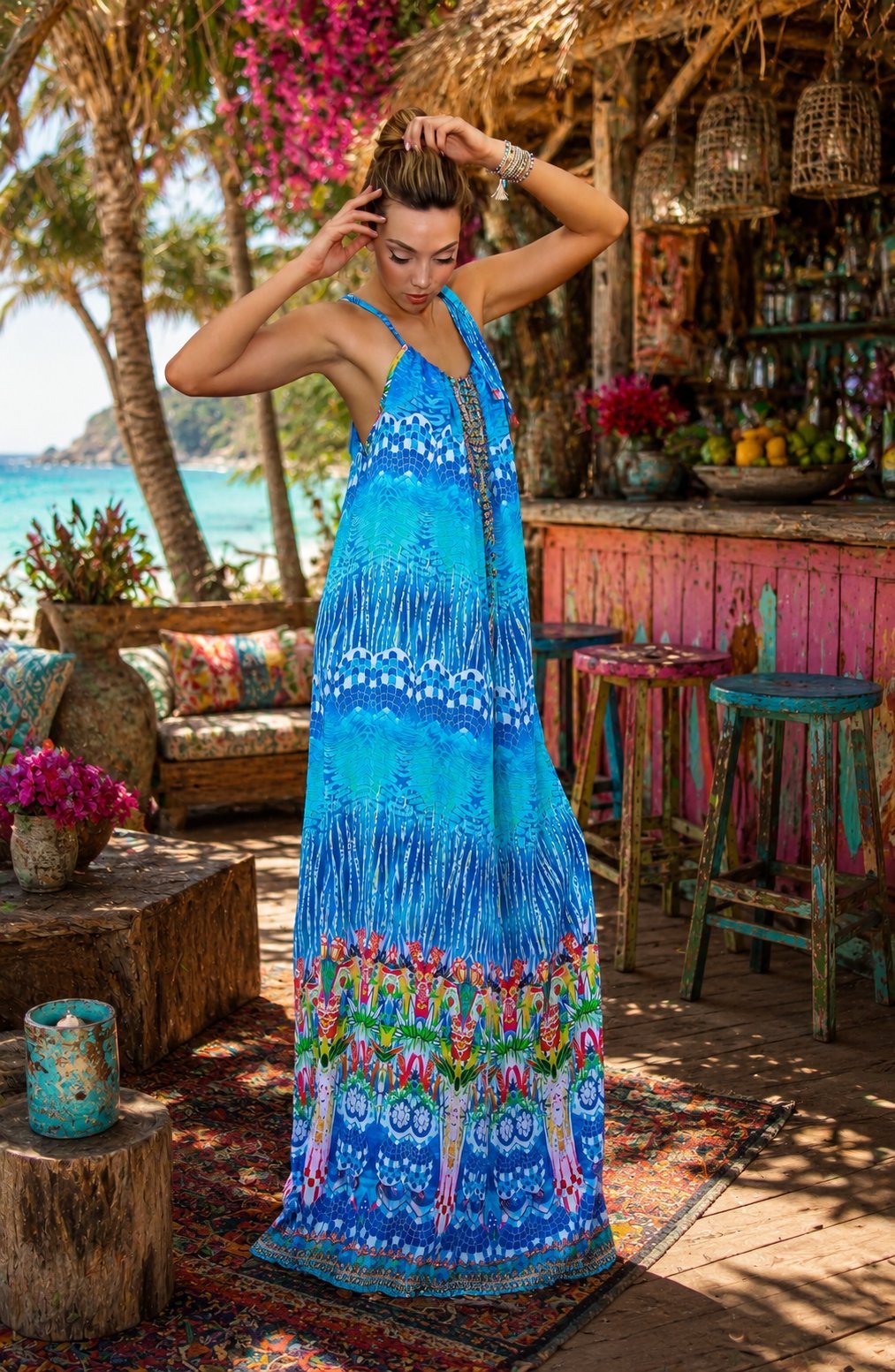
If you've shopped for resort wear in the last few years, you've seen both spellings — caftan and kaftan — used almost interchangeably. The truth: they're the same garment, just with different etymological histories. Both describe a long, loose, robe-like dress with origins in Persian and North African dress. But within the modern resort-wear category, the two spellings have come to imply slightly different aesthetics. Here's the practical buyer's guide.
Shop the full Caftans & Kaftans for Women collection →
The short version
-
"Caftan" is the more common American spelling. It often implies a slightly more luxe, contemporary resort-wear feel — think a beach-club caftan in $150-$250 range.
-
"Kaftan" is the more common British and global spelling. It often signals a more traditional, ethnographic, or bohemian aesthetic — block prints, ikat, tribal influences.
-
Both refer to the same silhouette: long, loose, sleeved (or sleeveless), worn over the head.
When to choose a caftan
A caftan is the right pick when you want a piece that reads "polished resort" — appropriate for a hotel dinner, a beach club lunch, a sunset photo op. The fabric tends to be lighter, the prints more modern, the silhouettes more shaped.
Featured caftans
When to choose a kaftan
A kaftan is the right pick when you want bohemian, eclectic, or culturally-inspired. Block prints, ikat, tribal motifs, and embroidery are kaftan territory. The cut tends to be more generously oversized and unstructured.
Featured kaftans
How to wear either, well
-
Belt to define the waist. Both caftans and kaftans look chic belted — a thin braided belt or a sash transforms the silhouette.
-
Choose your length. Knee-length = day. Ankle-length = day or evening. Floor-length = evening or beach club.
-
Accessorize sparingly. The print is the statement. One pair of statement earrings + flat sandals.
-
Layer over swimwear. Either works as a swim cover-up, especially shorter or knee-length cuts.
What is a caftan? Meaning and origin
A caftan (also spelled kaftan) is a long, loose garment with wide sleeves, cut to fall anywhere from the knee to the ankle. The word traces back to the Persian khaftān, a robe worn by royalty and merchants along trade routes across the Middle East, North Africa and Central Asia; it later became court dress in the Ottoman Empire and Morocco. In the 1960s and 1970s designers including Halston, Emilio Pucci and Valentino reworked it for jet-set resort wear, and it has been a vacation staple ever since. Whatever the price or print, the defining features stay the same: a loose, flowing body, wide sleeves, and room to move in the heat.
Types of caftans and when to wear them
-
Beach and pool caftans — sheer or semi-sheer chiffon or cotton, thrown over a bikini or one-piece. Tropical, animal and classic white prints all work.
-
Resort dinner caftans — floor-length, often beaded or embroidered, with a richer drape. A V-neck elongates; add statement earrings and strappy sandals for seaside dinners or cruise formal night.
-
Everyday summer caftans — breathable cotton for markets, coffee and errands. Short caftan tops work tucked into wide-leg pants or worn loose over shorts.
-
Loungewear caftans — soft cotton or rayon for home, garden brunches and slow Sundays.
Caftan fabrics: what to look for
-
Rayon and viscose — drape well and feel cool in humid heat; the best all-round hot-weather choice.
-
Cotton voile and gauze — breathable, soft and opaque for all-day beach wear.
-
Chiffon (usually polyester) — the most common evening-caftan fabric: elegant drape, photographs well and resists suitcase wrinkles, but warmer than rayon or cotton.
-
Linen and linen blends — the most breathable in extreme heat, but they wrinkle easily.
Finding a caftan that flatters your shape
The silhouette skims rather than clings, which is why caftans suit almost every body type. A few adjustments help:
- Want waist definition? Choose a built-in sash or drawstring, or add a belt.
- V-necks elongate the torso and flatter a fuller bust.
- Petite? A shorter length or a high-low hem keeps the fabric from overwhelming your frame.
- Prefer coverage? Long sleeves in an opaque fabric add sun protection; sheer fabrics with side slits read more beach club.
Club Moda caftans come in S–XL, S/M and L/XL two-size cuts, and one-size styles, with measurements on every product page.
How to care for a caftan
Check the care label first. Cotton and rayon caftans usually machine-wash on a gentle cycle and hang to dry; chiffon and silk styles are best hand-washed or dry-cleaned. For travel, roll rather than fold, then hang the caftan in a steamy bathroom to release any creases.
Frequently asked questions
Is there really a difference between caftans and kaftans?
Linguistically, no — they're the same garment, just different spellings ('caftan' is preferred in American English, 'kaftan' in British and global English). Within the modern resort-wear market, 'caftan' often signals more polished/luxe styling and 'kaftan' often signals more bohemian/ethnic styling, but this is a soft convention, not a rule.
Which is more dressy, a caftan or a kaftan?
Caftans (the spelling) tend to be marketed slightly dressier. Look for ankle-length silk-blend caftans for evening; oversized cotton kaftans skew more daytime.
Can you wear a caftan to a wedding?
Yes, for destination beach weddings. Pair an ankle-length, refined-print caftan with strappy sandals and statement earrings. Skip caftans for traditional or formal indoor weddings.
What's the best fabric for a caftan?
Rayon, viscose, silk-blend, and lightweight cotton. They drape beautifully and breathe in heat. Polyester caftans feel stiff and trap heat.
Are caftans appropriate for women over 50?
Caftans are arguably the most flattering, most age-versatile resort-wear piece available. They work beautifully at every age and body type.
Shop both spellings
Browse all caftans and kaftans at Club Moda, or the Spanish-language kaftanes y caftanes edit.